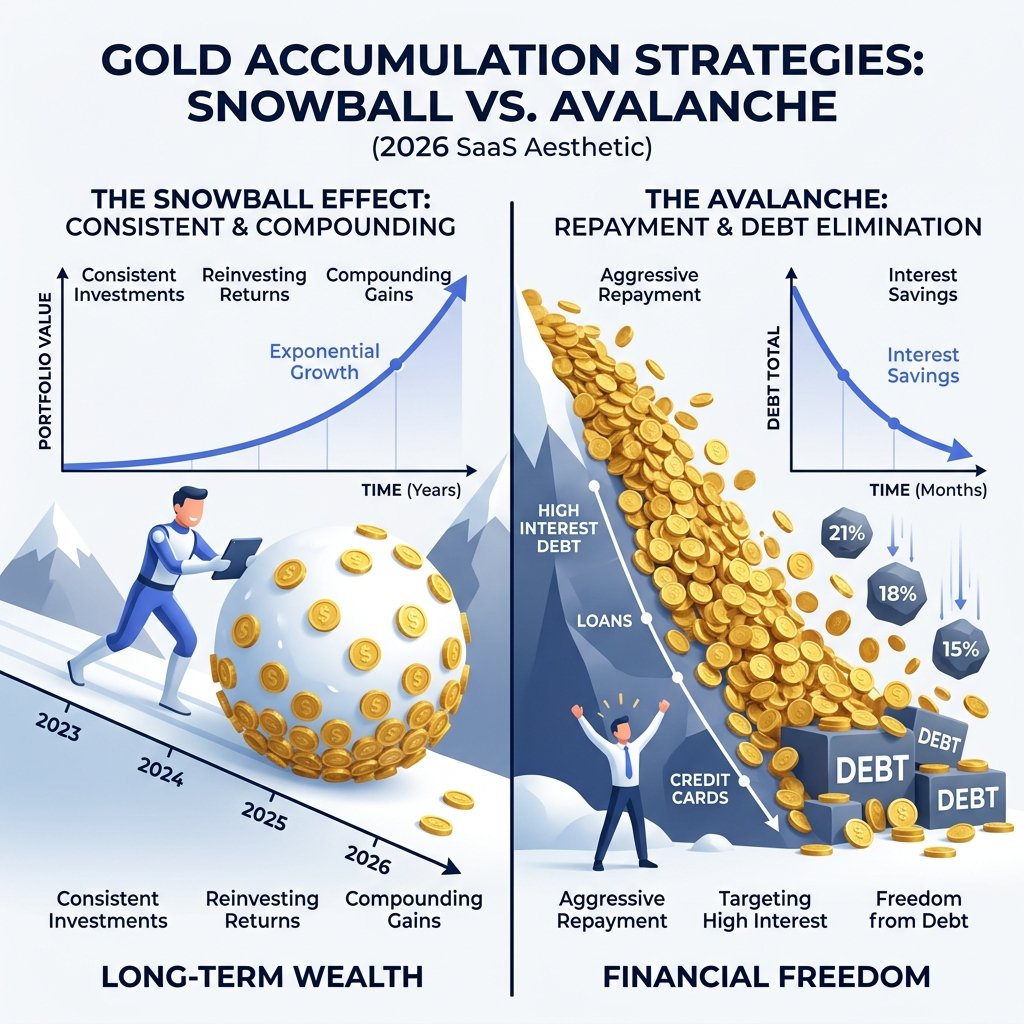
Debt Snowball vs. Debt Avalanche: The Ultimate Repayment Battle
The **Debt Snowball** method focuses on paying off the smallest balances first to gain psychological momentum, while the **Debt Avalanche** method targets the accounts with the highest interest rates first to minimize the total amount of interest paid. While the Avalanche is mathematically superior, research shows that the Snowball method often leads to higher completion rates due to the "small wins" effect.
Visualise Your Payoff Path
Compare how each method changes your debt-free date using our advanced debt payoff calculator.
Try the Debt CalculatorIntroduction: The War on Interest
If you're reading this, you've likely decided to take a stand against your debt. In America today, the average household carries over $7,000 in credit card debt, often spread across multiple cards with varying balances and interest rates. The "random payment" method—where you send a little extra to whichever card feels the most burdensome—is the least effective way to get clean. Instead, you need a system. The two heavy hitters in the world of personal finance are the **Debt Snowball** and the **Debt Avalanche**. In this comprehensive 2026 comparison, we break down which one will lead *you* to financial freedom.
1. The Debt Snowball: The Psychological Warrior
Popularized by financial personalities like Dave Ramsey, the Debt Snowball is all about "Human Behavior." It ignores the interest rates entirely (assuming they are all bad) and focuses on the balances.
How it Works:
- List your debts from smallest balance to largest balance.
- Pay the minimum on everything except the smallest debt.
- Attack the smallest debt with every extra dollar you can find.
- Once that debt is gone, take the entire payment you were making and "roll it over" into the next smallest debt.
The Pro: You get a fast "win." Paying off a $300 dental bill in month one gives you the dopamine hit needed to tackle a $5,000 credit card bill in year two. For those who have historically struggled with financial discipline, the debt payoff calculator often shows that the Snowball's "completion rate" is its secret weapon.
2. The Debt Avalanche: The Mathematical Genius
The Avalanche is the strategy for the person who loves spreadsheets. It ignores the sizes of the balances and looks only at the "cost of capital" (the APR).
How it Works:
- List your debts from highest interest rate (APR) to lowest interest rate.
- Pay the minimum on everything except the highest-interest debt.
- Attack the high-rate debt aggressively.
- Once it's killed, move the payment to the next highest interest rate.
The Pro: You save the most money. By killing a 29% interest card before a 12% student loan, you stop the most aggressive "interest bleed" immediately. If you put two identical scenarios into our debt payoff calculator, the Avalanche will *always* result in an earlier payoff date and lower total interest paid.
3. The Side-by-Side Math Case Study
Let's look at a typical US worker with three debts:
- Credit Card A: $4,000 at 24% APR (Min $100)
- Store Card B: $500 at 29% APR (Min $25)
- Medical Bill C: $800 at 0% APR (Min $50)
4. Which One Should You Choose in 2026?
Total "Interest Paid" isn't the only metric of success. If you start the Avalanche and get discouraged in month three because you haven't "paid anything off" yet, you have failed.
The Decision Matrix:
- Choose Snowball if: You are a "completer" who needs fast results to stay motivated. If you feel overwhelmed by the *number* of bills, choose this.
- Choose Avalanche if: You are mathematically driven and the thought of "wasting" money on interest makes your skin crawl. If you have high-balance, high-interest debt, choose this.
5. The "Hybrid" Approach: The Best of Both Worlds
In 2026, many US consumers use a hybrid model. They might kill one or two "tiny" debts (Snowball) to get the momentum going, then immediately switch to the highest-interest debt (Avalanche) for the remainder of their journey. This provides the initial boost of success followed by long-term mathematical efficiency.
6. Conclusion: The One Variable that Matters
Whether you choose the Snowball or the Avalanche, the most important factor is the **Consistency** of your payments. Use our debt payoff calculator to set a goal, automate your minimum payments, and never look back. The "math" vs. "psychology" debate is only relevant if you actually start. Pick a method today and reclaim your financial future.